

Lesson 1
बाज़ार में (In the Bazaar)
This lesson features a woman and her children shopping for vegetables and fruits.
In this lesson you will learn: simple greetings, the names of some vegetables and fruits, how to ask and answer simple questions, and how to ask prices and bargain.
Filmed in Aligarh, Uttar Pradesh, India.
Cast: Kausar Naqvi, Anamta Naqvi, Sabeel Naqvi
Writer & Director: Afroz Taj — Producer: John Caldwell — Executive Producer: Tony Stewart
Camera: Neil Hutcheson — Technical Consultant: Harold Levin.
Copyright: Afroz Taj and the U.S. Department of Education
A Door Into Hindi
Lesson 1 Script
Copyright US Dept. of Education
Right click to download an mp3 file of the audio track from the Lesson 1 Movie
यह बाज़ार है।
यह औरत है।

औरत: मैं ठीक हूँ, आप कैसे हैं?
दुकानदार: जी, मैं भी ठीक हूँ।
दुकानदार: जी नहीं, यहाँ गाजर नहीं है। 
औरत: टमाटर कैसे हैं?
दुकानदार: जी, टमाटर बहुत अच्छे हैं।
दुकानदार: जी, टमाटर का दाम पाँच रुपये किलो है।
औरत: टमाटर सस्ते नहीं हैं।
दुकानदार: जी नहीं, ये टमाटर सस्ते हैं।
औरत: पाँच रुपये बहुत हैं।
दुकानदार: जी, ये टमाटर चार रुपये हैं।
औरत: अच्छा। और लौकी का दाम क्या है?
दुकानदार: जी, लौकी का दाम दस रुपये।
औरत: अच्छा।
लड़की: माँ, यह क्या है?
औरत: यह करेला है।
लड़की: क्या यह मीठा है?
दुकानदार: जी, आपका नाम क्या है?
लड़की: मेरा नाम “दीपा” है। आपका नाम क्या है?
दुकानदार: जी, मेरा नाम “राजा” है।
दुकानदार: जी हाँ, ये बहुत सस्ते हैं।
दुकानदार: जी, तीन रुपये किलो है।
औरत: यह बैंगन है।
दुकानदार: जी, यह आपकी लौकी, ये आपके टमाटर …
दुकानदार: जी, धन्यवाद।
औरत: क्या यहाँ फल हैं?
दुकानदार: जी नहीं, यहाँ फल नहीं हैं।
दुकानदार: फल वहाँ हैं।
औरत: क्या यहाँ अंगूर है?
दुकानदार: जी नहीं, अंगूर नहीं है।
औरत: आम का दाम क्या है?
दुकानदार: आम का दाम पाँच रुपये किलो है।
दुकानदार: जी हाँ, ये बहुत मीठे हैं।
औरत: यह अनार है।
औरत: सब्ज़ी कहाँ है?
Copyright Afroz Taj
A Door Into Hindi
Lesson 1 Glossary
| यह |
this, he, she, it |
| है |
is |
| औरत |
woman [f.] |
| लड़की |
girl [f.] |
| लड़का |
boy [m.] |
| दुकानदार |
shopkeeper [m./f.] |
| नमस्ते |
a greeting |
| जी |
[honorific, used to show respect] |
| आप |
you |
| कैसी |
how? [f.] |
| हैं |
are |
| मैं |
I |
| ठीक |
fine, OK [adj.] |
| हूँ |
am |
| कैसे |
how? [m. pl.] |
| भी |
also, too |
| क्या |
what? |
| यहाँ |
here |
| गाजर |
carrot(s) [m.] |
| नहीं |
no, not |
| ये |
these, they |
| टमाटर |
tomato(es) [m.] |
| बहुत |
very, a lot |
| अच्छे |
good [adj. m.pl.] |
| का |
of [postposition] |
| दाम |
price [m.] |
| पाँच |
five |
| रुपये |
rupees [m.pl.] |
| किलो |
kilo(gram) [m.], per kilo |
| सस्ते |
inexpensive [adj. m.pl.] |
| चार |
four |
| अच्छा |
good [adj. m.s.] |
| लौकी |
bottle gourd [f.s.] |
| दस |
ten |
| माँ |
Ma (mother) [f.s.] |
| करेला |
bitter gourd [m.s.] |
| मीठा |
sweet [adj. m.s.] |
| नाम |
name [m.s.] |
| मेरा |
my |
| दीपा |
“Deepa” [proper name] |
| राजा |
“Raja” [proper name] |
| आलू |
potato(es) [m.] |
| कहाँ |
where? |
| हाँ |
yes |
| तीन |
three |
| बैंगन |
eggplant(s) [m.] |
| आपकी |
your |
| आपके |
your |
| पैसे |
money [m.pl.] |
| धन्यवाद |
thank you, thanks [m.s.] |
| और |
and |
| फल |
fruit(s) [m.] |
| वहाँ |
there |
| अंगूर |
grape(s) [m.] |
| आम |
mango(es) [m.] |
| अनार |
pomegranate(s) [m.] |
| सब्ज़ी |
vegetable [f.s.] |
| बन्दर |
monkey(s) [m.] |
| हाथी |
elephant(s) [m.] |
| तोता |
parrot [m.s.] |
| गाय |
cow [f.s.] |
| ऊँट |
camel(s) [m.] |
| आदमी |
man/men [m.] |
|
Grammar Topics
|
|
| » 1.1 Word Order | » 1.4 Articles |
| » 1.2 Questions – क्या, कहाँ, कैसे/कैसी | » 1.5 Punctuation |
| » 1.3 Negation with नहीं |
1.1 Word Order
Hindi word order is different from English word order. The most important difference is that the verb or verbal phrase almost always goes at the end of the sentence. In general, Hindi word order follows the following pattern:
Subject + Predicate + Verb
Examples:
|
|
|
|
|
My name |
Deepa |
is. |
|
मेरा नाम |
दीपा |
है। |
|
These tomatoes |
cheap |
are. |
|
ये टमाटर |
सस्ते |
हैं। |
|
This |
your squash |
is. |
|
यह |
आपकी लौकी |
है। |
1.2 Questions – क्या,कहाँ,कैसे
Most questions are formed by placing a question word (like “what” or “where”) right before the verbal phrase.
Examples:
|
Subject |
Predicate |
Question Word |
Verb |
|
Your name |
what |
is? |
|
|
आपका नाम |
क्या |
है? |
|
|
Vegetable |
where |
is? |
|
|
सब्ज़ी |
कहाँ |
है? |
|
|
This |
what |
is? |
|
|
यह |
क्या |
है? |
|
|
These tomatoes |
how |
are? |
|
|
ये टमाटर |
कैसे |
हैं? |
Any statement can be turned into a “yes-no” question by putting the question word क्या in front of the sentence. In this kind of question sentence, the word क्या is not translated.
Examples:
|
Question Word |
Subject |
Predicate |
Verb |
|
— |
Your name |
Deepa |
is? |
|
क्या |
आपका नाम |
दीपा |
है? |
|
— |
This |
sweet |
is? |
|
क्या |
यह |
मीठा |
है? |
Note that in English, this kind of “yes-no” question is usually made by putting the verb or auxiliary verb at the beginning of the sentence:
“Is your name Deepa?”
“Is this sweet?”
1.3 Negation
A sentence is negated by putting the word नहीं right before the verbal phrase.
Examples:
|
Subject |
Predicate |
Negation word |
Verb |
|
My name |
Deepa |
not |
is. |
|
मेरा नाम |
दीपा |
नहीं |
है। |
|
These tomatoes |
cheap |
not |
are. |
|
ये टमाटर |
सस्ते |
नहीं |
हैं। |
|
This |
your squash |
not |
is. |
|
यह |
आपकी लौकी |
नहीं |
है। |
1.4 Articles
Hindi does not have articles like the English words “the”, “a” or “an”. You can tell by the context whether a specific or general item is meant.
Examples:
|
Subject |
Predicate |
Verb |
|
[The] vegetable |
where |
is? |
|
सब्ज़ी |
कहाँ |
है? |
|
[A] fruit |
where |
is? |
|
फल |
कहाँ |
है? |
1.5 Punctuation
The end of a sentence is indicated by the Hindi “period” विराम, which is a vertical line “ | ” rather than the dot ( . ) as it is in English punctuation. Otherwise, the comma, exclamation point, question mark, etc. are used in Hindi just as they are in English.
Microwave ovens have only recently become common household items in South Asia. Refrigerators even now are used mostly for storing cold drinks and perishable goods, milk, butter, etc. and freezers are not frequently used to store leftovers for later consumption. Traditionally food is cooked fresh for every meal, and people go out to the markets every day to buy fresh vegetables and fruits. Although upscale grocery stores now exist in larger cities, most people purchase their fresh produce daily from itinerant carts or neighborhood vendors. Here, prices are not posted and it is expected that the shopper will bargain with the seller (see Culture 1.4 below).
One of the most common greetings in modern India is नमस्ते. नमस्ते is usually accompanied by the following gesture: place your palms together in front of your chest and make a slight bow. Here is an example:
Note: the literal meaning of नमस्ते is simply “[I] bow to you.” Although नमस्ते is associated with Yoga and other spiritual practices, it is essentially a secular greeting. There are many other greetings used in South Asia, most of which are associated with particular religious communities.
जी is an honorific particle that is used in conversation to indicate that a speaker respects the person they are addressing. It is usually added after the person’s name, or at the beginning of a sentence. You should always use it before the Hindi words for “yes” and “no”: “जी हाँ” and “जी नहीं.” It may also be used after a greeting: “नमस्ते जी”. जी should always be used when addressing strangers and people in formal settings like a workplace or classroom. Note how the shopkeeper in this lesson uses जी. It may also be used when talking (respectfully) about a third person by name, whether the third person is present or absent.
In the Urdu register, the words साहब [m.] and साहिबा [f.] are likewise used after proper names to indicate respect. There are a number of other respectful forms of address in Hindi-Urdu that we will learn later.
When shopping for anything (including vegetables) you are expected to haggle over the price (like people do for cars and houses in America). You ask the seller his price, and then you respond with a counter-offer, usually much lower. You can go through as many iterations as you like until a mutually agreeable price is reached – or not.
Many South Asian fruits and vegetables are not commonly available in the United States or Europe, although Asian specialty shops may carry some of them. For example, करेला (bitter gourd) is popular throughout Asia. Try it some time! Many people believe that South Asian vegetables, grown without artificial stimulants or greenhouses, are more flavorful than the ones grown in America. Note that each fruit or vegetable is only available during its particular harvest season: oranges in winter, mangoes in summer, etc. Lesson 4 (Review) contains more vocabulary for South Asian vegetables.
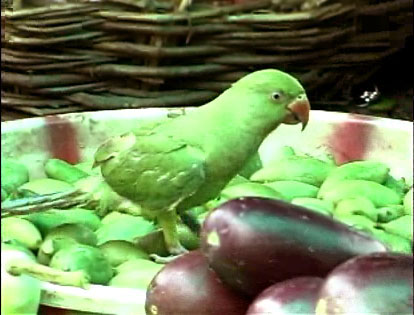
In most cities and towns in South Asia it is not uncommon to see unattended animals on the streets. They may be wild, or family livestock left free to wander the neighborhood. For example, in India many cows do not belong to anybody; they forage for a living. Cows are considered sacred by Hindus but they often help themselves to items they like from vegetable carts. In addition to domesticated horses, goats, buffaloes, pigs and donkeys, you will see stray dogs, monkeys and other animals roaming the streets. Some monkeys बन्दर and silver-haired apes लंगूर are kept on leashes as performing pets (see the Lesson 2 movie). Most monkeys and langoors are wild, however, and may be dangerous if provoked. Did you see the pet parrot and kitten (watch closely) in the Lesson One movie?
Lesson 1 Fill-in-the-blanks
Gap-fill exercise